
One of our clients gave their dev access to Cursor and said "add bulk CSV import - just like the single upload, but for multiple records." The dev built it in a day. It shipped five weeks later. Nobody had clarified: What happens with duplicate rows? What's the size limit? Do we validate in real-time or after upload? Should failed rows block the whole batch? Five weeks of Slack threads and meetings - for a feature that took one day to code.
Coding agents made development 10x faster. So why aren't projects shipping 10x faster?
Because the bottleneck was never the code. It's the back-and-forth between people - the questions, clarifications, and decisions that happen between every role on a team, at every stage of a project. We call it the iteration tax.
The simple math behind every delayed project
Every software project is a series of iterations - loops of questions asked, answers waited on, and decisions made. With coding agents making writing code super fast, the time a project actually takes comes down to two variables:
scope changes, clarifications
to the moment a decision is made
Coding agents crush the time it takes to write code. But they do almost nothing to reduce either of these two variables. The iterations still happen. The waiting is still there.
Where iterations hide in every project
Every feature, no matter how small, goes through some combination of these loops before it ships:
| Iteration | Sounds like... |
|---|---|
| PM ↔ PMIdea refinement | "Should we support bulk upload or just single? Let me check with the VP." |
| PM ↔ DesignUX iteration | "This flow has 7 steps. Users will drop off. Can we combine steps 3–5?" |
| PM ↔ EMFeasibility | "Real-time sync isn't possible with our current infra. Can we do polling instead?" |
| PM ↔ DevMid-dev surprises | "What happens when a user has two active subscriptions? The spec doesn't say." |
| PM ↔ QAScope clarity | "Should I test free tier too, or just paid plans?" |
| Dev ↔ QABug vs. feature | "This fails on Safari. Is that a bug or out of scope?" |
None of these are about writing code. They're about making decisions. And coding agents can't make decisions. And the later in the cycle these decisions get made - an edge case found during QA, a scope question that surfaces mid-dev - the more rework they trigger. Code already written, reviewed, and tested gets revisited or thrown out.
Why solo developers feel the 10x
For a solo developer, every iteration is a conversation with themselves. They hit an edge case, think about it, decide, and keep building. Same brain, zero coordination cost.
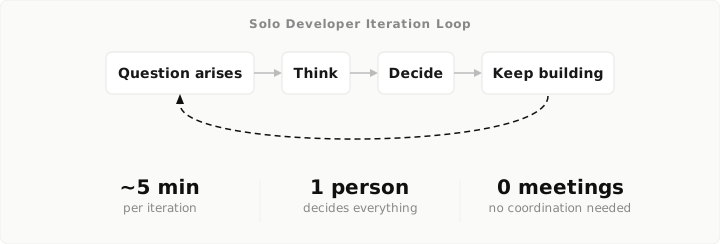
This is why indie developers and small teams report massive productivity gains from coding agents. The iteration tax is near zero - the agent just needs to build.
Why enterprises don't feel the 10x
In an enterprise, decisions are distributed. The person who hits the edge case isn't the person who can resolve it. The person who can resolve it is in a different team, a different timezone, or a different meeting.
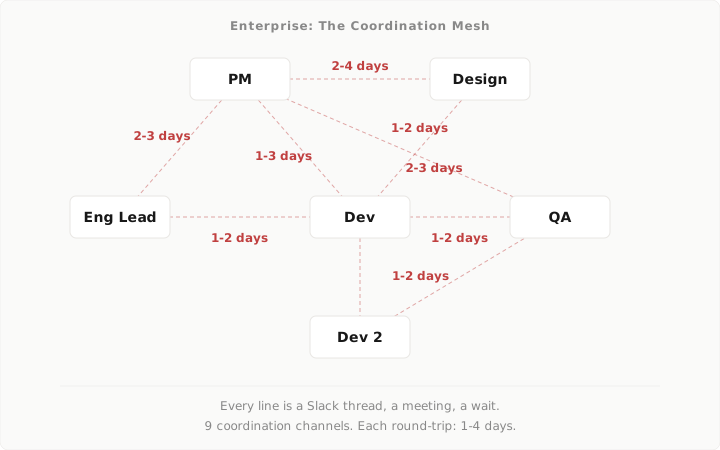
Let's trace what a single edge case looks like in this world:
Coding agents can build the code in minutes. But they can't attend the Thursday meeting. The iteration tax is the real bottleneck.
How to reduce the iteration tax
Every feature follows the same pipeline: product requirements, then design, then engineering planning, then dev. Each stage produces a spec that the next stage builds on. When a spec is incomplete - missing an edge case, an unclear flow, an unvalidated assumption - the next stage discovers it, and an iteration begins.
The fix isn't faster communication. It's making each stage more thorough. If product requirements already cover edge cases and feasibility, design doesn't need to ask. If design specs cover every state and constraint, engineering doesn't need to guess. If engineering planning covers impact areas and dependencies, dev doesn't hit surprises.
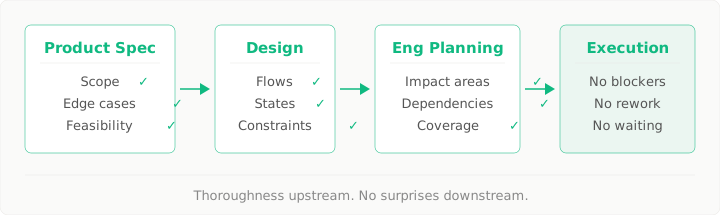
Promote thoroughness upstream, and the iterations downstream disappear.
Okay, now the product pitch
If you've made it this far, you probably agree that the iteration tax is real. What follows is how we built ProdE to solve it. Yes, this is where we talk about our product. You've been warned - feel free to bail if you got what you came for.
Still here? Cool.
The problem is that thoroughness is hard. It means someone needs to dig into the codebase, trace how things actually work today, and think through implications - real effort that nobody has bandwidth for in a 30-minute planning session.
That's what ProdE is built to do. It connects to your codebase, understands your product, and gives every role on your team the ability to be thorough independently - without waiting on each other.
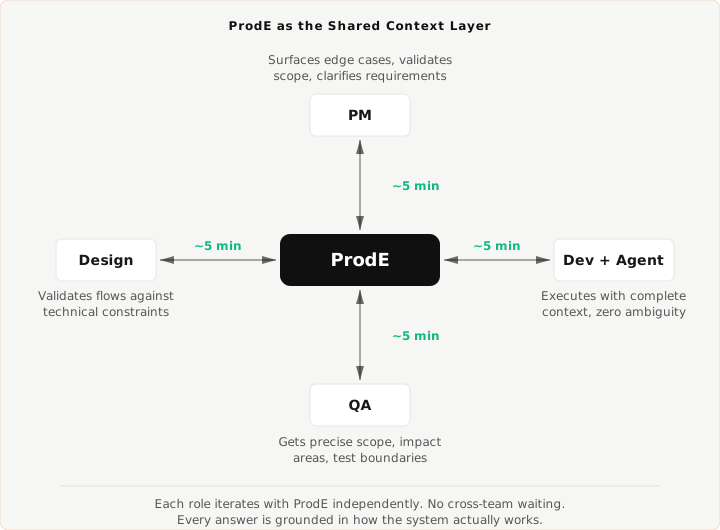
PMs brainstorm with ProdE to surface edge cases from the actual code, not from memory. Design validates flows against real technical constraints. Devs and coding agents get complete specs with zero ambiguity. QA gets precise impact areas. Each role gets answers in minutes - no cross-team waiting, no Thursday meetings for a yes-or-no question.
Same question, two very different outcomes
Remember the "two active subscriptions" edge case that took 3 days to resolve? Here's what that looks like with ProdE in the loop:
The question is the same. The difference is when it gets asked and who has the context to answer it. ProdE surfaces questions upstream - where they're cheap and can be immediately answered - instead of letting them surface downstream, where they're expensive.
The bottleneck was never the code
Coding agents solved the build bottleneck. That exposed the real one - the iteration tax. For solo developers, it's near zero. For enterprises, it's where projects go to die. ProdE doesn't make your agents faster. It makes sure they don't have to stop and ask.
See how ProdE reduces iteration tax for you
Get a demo